






As microservices architectures become the standard, service mesh technologies like Kuma are transforming the way organizations secure, connect, and monitor their applications. Developed by Kong and designed to run in both Kubernetes and traditional VM environments, Kuma offers a universal and scalable service mesh platform built for simplicity and performance.
In this article, we’ll explore what Kuma is, its core features, how it works, and why it stands out in the service mesh ecosystem.
What is Kuma?
Kuma is an open-source universal service mesh designed to support modern service connectivity patterns across Kubernetes, virtual machines (VMs), and bare-metal servers. It provides powerful features like traffic routing, security, observability, and multi-tenancy, all with a developer-friendly API and a centralized control plane.
Kuma is powered by Envoy Proxy, the same high-performance proxy used by Istio, and is governed by the CNCF (Cloud Native Computing Foundation).
Key Features of Kuma
1. Multi-Environment Support (K8s + VMs)
Unlike service meshes built exclusively for Kubernetes, Kuma supports hybrid infrastructure, making it ideal for organizations transitioning to Kubernetes from legacy systems.
2. Built-in mTLS and Service Authentication
Kuma automatically enables mutual TLS (mTLS) between services, encrypting all traffic and enforcing service-to-service authentication.
3. Fine-Grained Traffic Policies
With Kuma, you can implement traffic rules such as:
- Canary deployments
- Blue/green deployments
- Weighted traffic splitting
- Retry and timeout policies
4. Service Discovery and Routing
Kuma provides cross-zone and multi-cluster service discovery, enabling seamless service communication across regions or clouds.
5. Observability and Monitoring
Integrates easily with Prometheus, Grafana, and other tools to provide metrics, logs, and traces out of the box.
6. Multi-Tenancy with Workspaces
Kuma supports multi-tenancy through its workspace model, allowing isolated control over policies and services within the same mesh.
7. Native Kubernetes CRDs + Standalone Mode
You can deploy Kuma in:
- Kubernetes mode using CRDs
- Universal mode for VMs and bare-metal servers
This flexibility makes Kuma suitable for diverse infrastructure setups.
How Kuma Works
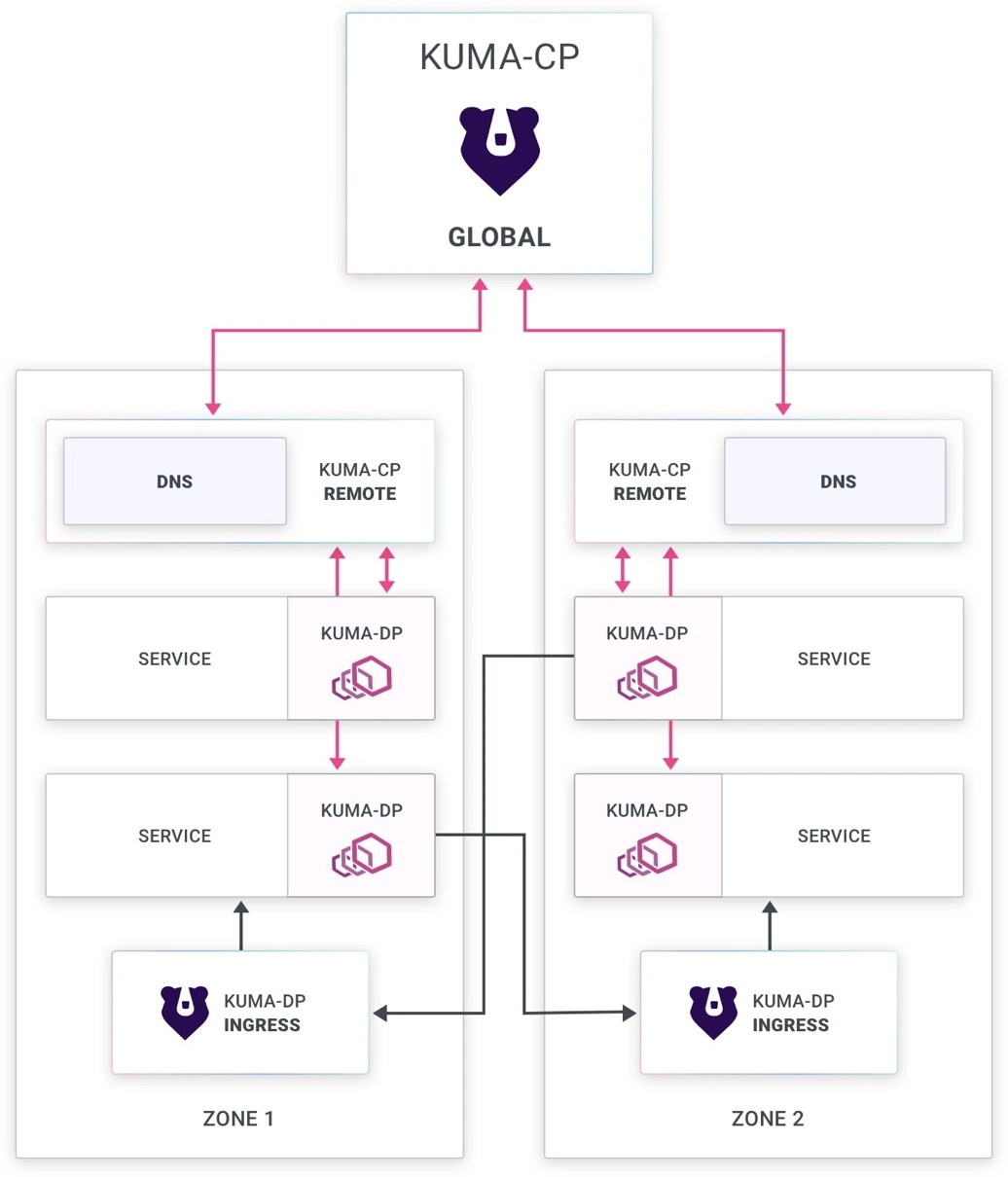
Kuma uses a control plane and data plane architecture:
- Control Plane (Kuma CP): Manages configuration, policies, and service discovery.
- Data Plane (Envoy): Each service runs an Envoy proxy that enforces the policies configured in the control plane.
All service-to-service traffic flows through these sidecar proxies, allowing Kuma to manage security, traffic routing, and observability transparently.
Benefits of Using Kuma
- Universal support for K8s, VMs, and bare-metal
- Simple APIs and policies for fast configuration
- Lightweight and scalable architecture
- Developer and platform friendly UX
- Zero-trust security model with built-in mTLS
Use Cases
- Enterprises with hybrid infrastructure
- Organizations implementing multi-cloud strategies
- Teams looking to simplify traffic routing and policy enforcement
- Modern DevOps pipelines requiring secure, observable, and resilient communication
Getting Started with Kuma on Kubernetes
- Install Kuma:
kumactl install control-plane | kubectl apply -f -
- Inject Kuma sidecar into your service:
kubectl label namespace default kuma.io/sidecar-injection=enabled
- Deploy your applications and define traffic policies using CRDs or REST API.
- Access the dashboard:
kubectl port-forward svc/kuma-control-plane -n kuma-system 5681:5681
Kuma vs Istio vs Linkerd
| Feature | Kuma | Istio | Linkerd |
|---|---|---|---|
| Hybrid support (K8s+VMs) | ✅ | ❌ | ❌ |
| Ease of use | ✅ | ❌ | ✅ |
| Built-in multi-tenancy | ✅ | ❌ | ❌ |
| mTLS support | ✅ | ✅ | ✅ |
| Extensibility | Moderate | High | Low |
Conclusion
Kuma is a versatile and modern service mesh that simplifies application networking across heterogeneous environments. Whether you’re operating in pure Kubernetes, hybrid cloud, or a legacy VM environment, Kuma offers a unified, secure, and scalable solution for service connectivity and observability.
Keywords: What is Kuma, Kuma service mesh, universal service mesh, Kuma vs Istio, Kuma Kubernetes setup, mTLS service mesh, Kuma features, Kong Kuma
Hướng dẫn cài đặt Cluster Kafka trên Ubuntu
https://forum.congdonglinux.com
Top 5 Service Meshes for Kubernetes: A Detailed Comparison and How to Choose
Add Comment