






In a microservices architecture, managing service-to-service communication, security, and observability can quickly become complex. This is where Istio, one of the most powerful service meshes for Kubernetes, steps in. With its robust feature set, Istio allows platform teams to control traffic, enforce policies, secure services, and monitor communications without modifying application code.
In this guide, we’ll explore what Istio is, how it works, and why it has become a go-to solution for enterprises running cloud-native applications.
What is Istio?
Istio is an open-source service mesh platform that provides a way to control how microservices share data with one another. Developed by Google, IBM, and Lyft, Istio was designed to solve the challenges of managing service-to-service communication in a distributed, containerized architecture—primarily within Kubernetes clusters.
Key Features of Istio
1. Traffic Management
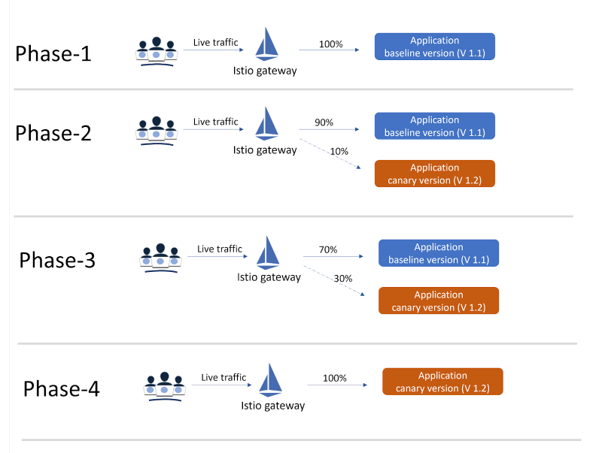
Istio lets you control the flow of traffic between services with advanced routing rules like:
- Canary deployments
- A/B testing
- Traffic mirroring
- Load balancing These features help you safely roll out changes and reduce the risk of failures.
2. Security with mTLS
Istio automatically enables mutual TLS (mTLS) between services, encrypting communication and verifying identities. This simplifies zero-trust security models in cloud-native applications.
3. Observability and Telemetry
With integrations like Prometheus, Grafana, Jaeger, and Kiali, Istio provides:
- Real-time traffic monitoring
- Distributed tracing
- Access logging
- Metrics collection
4. Policy Enforcement
Administrators can define and enforce policies such as:
- Rate limits
- Quotas
- Access controls (RBAC)
- Request authentication and authorization
5. Extensibility
Istio supports Envoy filters, WebAssembly (WASM) extensions, and other plug-ins to add custom behavior to the mesh.
How Does Istio Work?
Istio is built on three main components:
- Envoy: A high-performance proxy that sits alongside your services (sidecar) and handles traffic.
- Istiod: The control plane that configures the proxies and manages policies.
- Mixer (deprecated): Previously used for policy enforcement and telemetry, now replaced with native integrations.
When a service in your Kubernetes cluster sends a request, the request goes through the Envoy proxy. Istio intercepts the traffic and applies rules for routing, security, and observability, all without touching the application code.
Benefits of Using Istio
- Decouples infrastructure concerns from application logic
- Strengthens security through automatic mTLS
- Simplifies A/B testing and traffic splitting
- Provides detailed monitoring and logs
- Enhances system reliability with retries, circuit breakers, and timeouts
Use Cases
- Secure microservices with strong identity-based access control
- Progressive delivery using canary or blue-green deployments
- Monitoring and debugging distributed systems
- Centralized policy enforcement across teams
Challenges and Considerations
While Istio is feature-rich, it comes with some complexity:
- Steep learning curve for beginners
- High resource usage in large clusters
- Operational overhead compared to lighter solutions like Linkerd
These challenges can be mitigated with good architecture, automation, and proper monitoring.
Who Uses Istio?
Many organizations across industries, including finance, healthcare, and cloud service providers, use Istio to manage production-grade microservices, especially in regulated environments that demand strong security and visibility.
Getting Started
To try Istio on your Kubernetes cluster:
curl -L https://istio.io/downloadIstio | sh -
cd istio-*
export PATH=$PWD/bin:$PATH
istioctl install --set profile=demo -y
Then deploy your services and observe the mesh in action!
Conclusion
Istio is a powerful and mature service mesh that offers fine-grained control over traffic, security, and observability in Kubernetes. While it may require a steeper learning curve, its capabilities make it an essential tool for operating resilient, secure, and scalable microservices in the cloud-native era.
Keywords: What is Istio, Istio service mesh, Kubernetes service mesh, Istio vs Linkerd, secure microservices with Istio, Istio features, Istio tutorial
https://forum.congdonglinux.com
Top 5 Service Meshes for Kubernetes: A Detailed Comparison and How to Choose
Add Comment